How to Get Cash for Junk Cars Fast
June 17, 2026
Is Cash for Junk Cars Legit? Yes, Sometimes
June 19, 2026
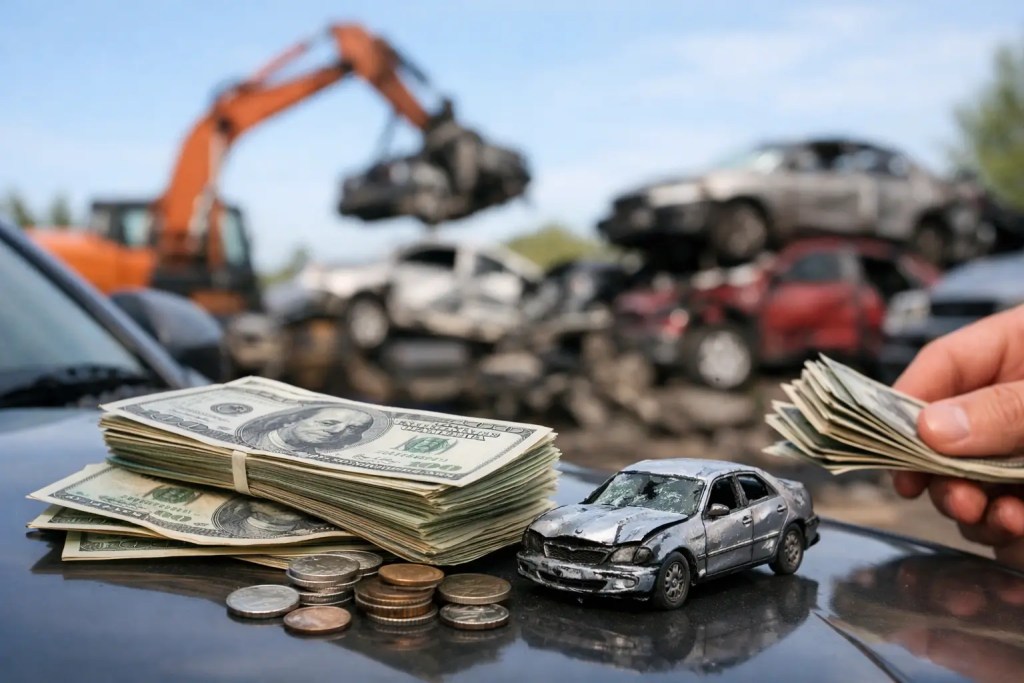
That old car sitting in the driveway is worth something, even if it will not start, has body damage, or has been parked for months. If you are wondering how much cash for scrap cars is realistic, the short answer is this: it depends on the vehicle’s weight, parts value, condition, title status, and how easy it is to pick up. Some scrap cars bring a couple hundred dollars. Others bring far more.
The problem is that many sellers hear one number from a national ad, another from a local buyer, and a completely different number from a tow yard or salvage company. That creates confusion fast. If you want a fair offer, you need to know what actually moves the price.
How much cash for scrap cars depends on more than scrap metal
A lot of people assume scrap cars are priced like soda cans by the pound. Scrap metal matters, but it is only one part of the picture. A buyer is looking at what the car is made of, what condition it is in, whether any parts still have resale value, and what it will cost to haul it away.
A compact sedan with a blown engine may still be worth decent money if the transmission, wheels, catalytic converter, and body panels are usable. A larger SUV might weigh more and bring more as raw scrap, but if it is stripped, missing key components, or badly damaged, the value can drop. That is why two vehicles that look equally “junked” can get very different offers.
Market timing matters too. Scrap metal prices change. Used parts demand changes. Fuel and towing costs change. A fair quote today may not match what the same car would have brought six months ago.
What buyers look at before making an offer
The year, make, and model matter because some vehicles have parts that sell well and some do not. Common vehicles with interchangeable parts can sometimes hold more value than people expect. On the other hand, a rare car with little parts demand may be worth less than its size suggests.
Condition also matters, even for scrap. If the engine is dead but the rest of the vehicle is complete, that usually helps. If the car has front-end damage but the rear body, doors, wheels, and interior are intact, that can help too. Missing major components like the catalytic converter, battery, wheels, or transmission can reduce the offer.
Title status can make a real difference. A vehicle with a clear title is usually simpler to buy, transport, and process. If there is no title, some buyers may still purchase it depending on state rules and the situation, but the process can be slower and the offer may be lower. If you are trying to sell quickly, paperwork matters.
Location affects price more than most people think. If the car is easy to access, sitting on inflated tires, and ready for pickup, that helps. If it is stuck in mud, blocked in a tight space, missing wheels, or sitting in a garage that requires extra labor to remove it, the buyer has to factor that in.
Typical price ranges for scrap cars
There is no single price that fits every vehicle, but most scrap cars fall into a practical range. A very small, stripped-down car with serious damage and low parts value may bring only a few hundred dollars. A complete vehicle with valuable parts, a catalytic converter still attached, and easy pickup can bring more.
As a rough ballpark, many unwanted cars land somewhere between $200 and $800. Some come in below that. Some go above it, especially if the vehicle is newer, heavier, complete, or still has in-demand components. Trucks, vans, and SUVs can sometimes bring more than smaller cars, but not always. If they are heavily damaged or missing major parts, the extra size does not automatically mean a higher payout.
This is where sellers get tripped up. They compare their car to a friend’s sale without comparing the details. A non-running 2012 sedan with all parts present is not the same as a stripped 2008 SUV with no title. The category may be the same, but the value is not.
How to get a better idea of how much cash for scrap cars you can get
If you want a realistic quote, be specific. Give the year, make, model, whether it runs, whether the title is in hand, and what damage or missing parts the vehicle has. If the tires are flat, say so. If the catalytic converter is gone, say so. If the car starts but cannot be driven safely, say that too.
Honest details usually help, not hurt. A buyer who has clear information can give a stronger quote and show up prepared. A vague description often leads to a softer estimate because the buyer has to leave room for surprises.
Photos can help when there is major damage. They are especially useful if the car was in an accident, has fire damage, flood damage, or severe rust. A quick photo of each side, the interior, and the engine area can answer questions before pickup day and prevent last-minute changes.
You should also ask one simple question that matters more than people realize: is towing included? A high quote is not really a high quote if pickup fees get deducted later. Free pickup can make a meaningful difference in what you actually put in your pocket.
Why one buyer offers more than another
Not all vehicle buyers handle scrap cars the same way. Some are buying for raw scrap only. Some are buying for usable parts first and scrap second. Some rely on third-party towing. Some have their own trucks, drivers, and local coverage.
That changes the math. A local buyer with in-house towing may be able to pay more because the logistics are easier and cheaper. A buyer who knows the local market may also have a better sense of which parts can be resold. In a place like Tampa, where fast removal and easy scheduling matter, local service can make a real difference in both speed and offer quality.
This is also why the fastest deal is not always the cheapest deal, and the highest quote is not always the best deal. If a company takes days to show up, changes the number on arrival, or adds towing charges, the headline price stops looking attractive.
The biggest mistakes sellers make
One common mistake is waiting too long. If a car is sitting and deteriorating, the value can drop over time. Tires go flat, rust gets worse, parts disappear, and access becomes harder. The longer it sits, the more likely it is to become a more complicated pickup.
Another mistake is cleaning up the wrong things. You do not need to spend money fixing a scrap car to sell it. Major repairs almost never pay off in this situation. What does help is removing personal items, finding the title, and making sure the vehicle can be accessed safely.
Some people also accept the first number they hear without asking what is included. Ask whether the quote is final based on the details you gave. Ask whether there are any deductions for towing, missing paperwork, or difficult pickup conditions. Straight answers matter.
When a car is worth scrapping instead of repairing
If the repair bill is more than the vehicle’s market value, scrapping often makes sense. The same goes for cars with major engine or transmission failure, severe accident damage, flood damage, or long-term neglect. High-mileage vehicles can also cross that line when they need multiple expensive repairs at once.
There is also the time factor. Even if a repair is technically possible, it may not be practical if you need the vehicle gone now. A quick sale can save you from storage issues, HOA complaints, registration headaches, or ongoing insurance costs on a car you no longer use.
For many sellers, the real value is not just the cash. It is cash plus removal plus speed. No listings. No no-shows. No waiting around for a private buyer who wants to negotiate over a car that does not run.
What a fair scrap car process should look like
It should be simple. You provide the vehicle details. The buyer gives you a quote based on those details. Pickup gets scheduled. The vehicle is removed, paperwork is handled properly, and you get paid as agreed.
That is what people want when they are dealing with an unwanted car. Fast response. Clear communication. No haggling. No hassle. If a company makes the process confusing, drags out pickup, or gets slippery about payment, keep looking.
A fair offer is not always the highest number said on the phone. It is the number that holds up, includes pickup, matches the condition of the vehicle, and gets the job done without wasting your time.
If you are asking how much cash for scrap cars you can get, the best answer comes from real details, not guesses. Every vehicle has its own value, and the right buyer will tell you what that number is clearly and quickly. When the car is done, the next step should be easy.